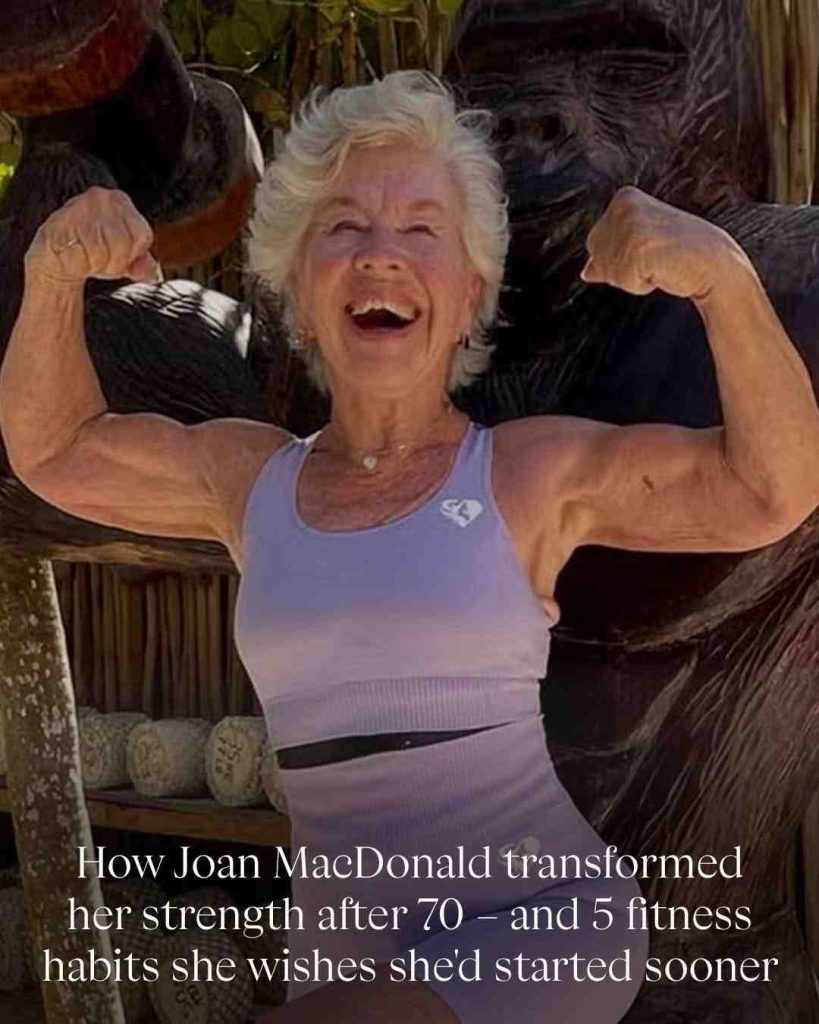
Most people don’t expect to completely reinvent their health at 70.
By that age, many have already accepted certain things as permanent: stiff joints, less energy, weaker muscles, slower movement, and the idea that strength training belongs to younger people.
Joan MacDonald didn’t accept that.
When she began changing her lifestyle at 70, she was nearly 200 pounds, struggling with mobility, dealing with arthritis and taking medication for high blood pressure, cholesterol and acid reflux. She had also undergone a knee replacement, and even climbing stairs had become difficult.
Today, Joan is 80 and still training. What started as an attempt to improve her health turned into a transformation that brought her millions of followers and eventually became the Train With Joan fitness community.
But the most interesting part of her story isn’t how different she looks.
It’s how differently she moves.
She didn’t start as a lifelong athlete
That is what makes Joan’s story relatable.
She wasn’t somebody who had been lifting weights since her twenties and simply continued into old age.
In January 2017, her daughter Michelle, a fitness coach, became increasingly concerned about her health and encouraged her to make a serious change. Joan agreed to begin training and joined a group of women working on strength and nutrition.
At first, the changes were manageable.
She started with relatively short periods of exercise, including cardio and lighter resistance work. As she became stronger, her daughter gradually increased the challenge by adding resistance, repetitions or weight.
That gradual progression mattered.
Joan didn’t walk into a gym on her first day and attempt the workouts she performs now.
She built her strength slowly.
Month after month, things that once felt impossible became normal.
Within the first six months, she had lost around 40 pounds, and her strength and mobility continued improving afterward.
Years later, videos would show her performing exercises such as deadlifts, hip thrusts and weighted strength movements that many people would find demanding at any age.
Her transformation is a reminder that the body you have today does not necessarily determine what your body will be capable of several years from now.
1. She wishes more people understood the importance of strength training
If there is one habit at the center of Joan’s transformation, it is resistance training.
She began with four strength-training days each week plus a yoga session, gradually increasing her training as her fitness improved. Later, she moved toward five weight-training sessions per week.
Strength training becomes particularly valuable as we get older because muscle mass and strength naturally tend to decline with age. Resistance exercise can help maintain muscle and bone strength while also supporting balance, everyday function and independence.
But Joan’s example also shows something important:
You don’t need to begin by lifting heavy.
Start where you are.
A few exercises with manageable resistance can eventually become something much more challenging.
The goal isn’t to prove how strong you are on day one.
The goal is to become a little stronger than you were last month.
2. She learned that consistency matters more than enthusiasm
Almost everybody can feel motivated for a week.
The harder part is doing something when it stops feeling exciting.
Joan has been remarkably consistent since beginning her fitness journey nearly a decade ago. Her results didn’t come from one dramatic 30-day challenge; they came from repeatedly training, adjusting her nutrition and gradually improving.
There were undoubtedly easier days and harder ones.
That is normal.
What matters is that missing one perfect workout doesn’t become permission to abandon the entire routine.
This is probably one of the most useful lessons for anyone starting later in life.
You don’t need a perfect week.
You need enough good weeks stacked together.
3. She stopped treating food as an afterthought
Exercise was only part of Joan’s change.
Nutrition became more structured too.
She has described learning to track the balance of protein, carbohydrates and fats in her meals, eating more deliberately and slowing down instead of constantly snacking.
That didn’t mean surviving on tiny salads.
The goal was learning how food supported the work she was doing in the gym.
Protein became particularly important because it supports muscle maintenance and recovery.
Her approach became less about punishing herself for eating and more about fueling the body she was trying to strengthen.
That mindset is very different from the diet culture many older women grew up around.
Instead of endlessly trying to become smaller, Joan began trying to become stronger.
4. She embraced gradual progression instead of rushing
One detail from Joan’s story deserves more attention.
Whenever she reached a plateau, the difficulty of her workouts changed.
Sometimes she added repetitions.
Sometimes resistance.
Sometimes weight.
That gradual progression is one of the foundations of strength development.
People often become discouraged because they compare their beginning with someone else’s tenth year.
Joan’s current strength wasn’t built in the first month.
It was accumulated.
That is a much more encouraging way to think about exercise after 60 or 70.
Maybe today you can only perform a movement using body weight.
Later you might use a resistance band.
Then a light dumbbell.
Months later, perhaps something heavier.
Every stage counts.
5. She stopped believing age should decide what she was capable of
This may be the biggest change of all.
Joan’s physical transformation is obvious, but her attitude toward aging changed too.
Her own platform now focuses heavily on challenging the belief that getting older automatically means becoming helpless, weak or unable to improve.
That doesn’t mean pretending age has no effect on the body.
It does.
Recovery can change.
Joints can require more consideration.
Medical conditions matter.
But there is a major difference between respecting your limitations and assuming improvement is impossible.
Joan chose the first.
She worked within her abilities and kept expanding them.
The real transformation wasn’t the weight loss
Before-and-after photographs naturally attract attention.
Joan lost a substantial amount of weight. Her body composition changed dramatically.
But focusing only on the number on the scale misses the best part of the story.
At 70, she struggled with stairs.
Years later, she was lifting weights confidently and moving with far greater strength.
That is a completely different measure of success.
Can you carry your groceries?
Can you get out of a chair comfortably?
Can you travel?
Can you play with grandchildren?
Can you walk without constantly worrying about whether your body will cooperate?
Those things become extraordinarily valuable as the years pass.
You don’t have to train like Joan to learn from her
There is an important distinction here.
Joan’s current workouts are advanced.
A beginner in their seventies should not simply copy everything they see her doing online.
Anyone with significant health conditions, previous injuries or concerns about exercise should speak with a qualified healthcare professional before beginning a demanding strength program.
The lesson from Joan isn’t:
“Lift what she lifts.”
It is:
“Start with what you can do, then patiently build from there.”
For one person, that might mean walking for ten minutes.
For another, resistance bands.
For someone else, learning how to squat safely to a chair.
The starting point matters far less than actually having one.
Nearly a decade later, she is still going
That may be the strongest part of her story.
Joan didn’t transform herself for a photograph and then disappear.
She kept training.
She kept learning.
She kept sharing the process.
At 80, roughly a decade after deciding she wanted something different for herself, she remains active and continues encouraging other older adults to build strength.
There is something reassuring about that.
You don’t have to have started at 30.
You don’t have to have been athletic at 40.
You don’t have to look back at 50 or 60 and regret all the years you didn’t exercise.
You can only start from the age you are today.
And Joan MacDonald’s story makes a convincing case that today may still be early enough.

