An overlooked crisis
During the war, oil and gas shortages led Japan to turn to the nation’s most abundant natural resource – forests – as a source of fuel for home and industry. The result was widespread deforestation of natural forests, with the mountains around major cities like Tokyo, Osaka and Kobe completely stripped bare of trees.
“After World War Two, many of Japan’s mountains became barren, causing disasters in various regions,” says Noriko Sato, a professor and forestry researcher at Kyushu University in Fukuoka, Japan. (Bare mountains can increase the incidence of landslides and flooding). “Large-scale afforestation was carried out by public works, funded by tax revenues, to prevent soil erosion.”
Aiming for rapid reforestation, the government chose to plant reams of only two different native, fast-growing evergreen species that could quickly reforest landscapes and provide wood for future use in construction: the Japanese cedar, sugi, and the Japanese cypress, hinoki.
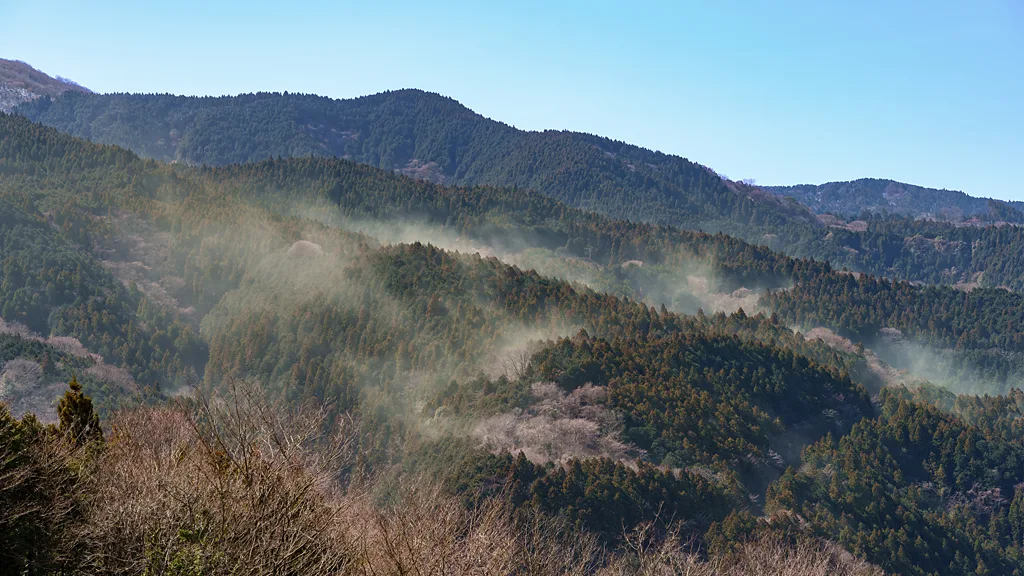
Each spring in Japan, reams of pollen waft off Japanese cedar and cypress plantations, often floating towards cities where it causes hay fever
Today, these hinoki and sugi plantation forests still cover around 10 million hectares (25 million acres) – a fifth of Japan’s entire land area.
The problem is, sugi and hinoki trees also produce large amounts of lightweight pollen which can easily drift into cities. It’s this pollen, often released all at once from the monoculture plantations, that is responsible for most seasonal allergies in Japan. The issue has become all the worse since these trees release ever more pollen after maturing at 30 years of age – now the case for nearly all of them.
“Pollen allergies have become a national health issue in Japan,” says Sato. “Addressing this problem is urgent.”
In 2023, Japan declared allergies a national social problem and the central government set out an ambitious plan – reduce pollen by 50% in 30 years. As a first step, it aims to reduce the forest areas planted with sugi trees by 20%.
But swapping out forests covering over 2% of Japan in 10 years is a massive endeavour. Plus, simply cutting these trees down won’t be enough – they also need to be replaced with new forests to avoid soil erosion or accidentally undercutting Japan’s own climate targets.
Return to life
Walking through sugi or hinoki plantation forests is eerie – all the trees are the same height and there are few birds or insects. The ground is spongy with dry needles, and there’s little light or sound.
It’s a stark contrast to Japan’s natural forests, which teem with biodiversity and sound. With their diverse tree species like red pine, larch and maple, these forests support more of all kinds of wildlife. Japan’s unique geography has made it one of the world’s biodiversity hotspots, but habitat loss and invasive species have led much of its unique wildlife to become increasingly at risk.
With the monoculture plantation forests causing so many problems, it makes sense that Japan is now trying to replace them with something better. But it’s a daunting challenge. The reason? Japan has a lot of forests. In fact it’s one of the most forested industrialized nations in the world, with forests covering 68% of its land, a third of which are sugi and hinoki plantations. The US, by contrast, is 34% forested; the UK just 13%.
Across Japan, forests can be found right by cities. Japanese even has a word for the transition area between city and forest: satoyama.

Japanese people spend huge amounts on anti-allergy products, and the country is developing new medicines from long-lasting treatments to anti-allergy rice
READ MORE ON THE NEXT PAGE..

