A Surprising New Perspective on a Common Hormonal Disorder
Polycystic ovary syndrome (PCOS) is one of the most prevalent endocrine disorders affecting women of reproductive age, impacting an estimated 6–13% of women worldwide. Traditionally associated with irregular menstrual cycles, elevated androgen levels, infertility, and metabolic complications, PCOS has long been viewed primarily through the lens of reproductive dysfunction.
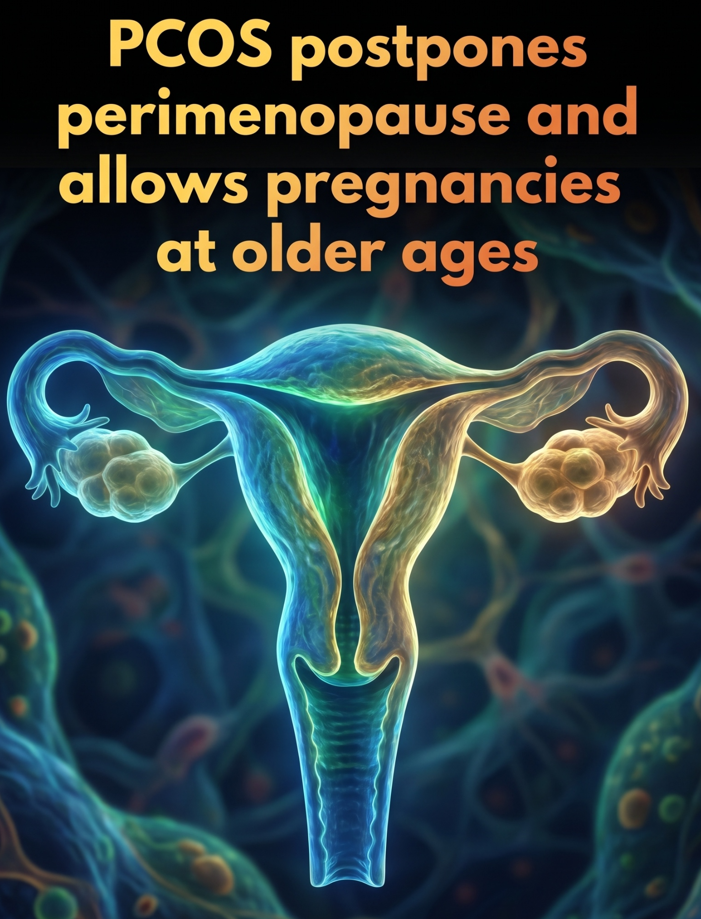
However, emerging evidence suggests that the long-term reproductive trajectory of women with PCOS may differ significantly from that of women without the condition. A recent population-based study from Finland has revealed an unexpected phenomenon: women with PCOS appear to experience a later menopausal transition and may retain reproductive potential longer than previously believed.
These findings challenge conventional assumptions about reproductive aging and offer new insights into the complex biology of ovarian function.
Understanding PCOS
PCOS is characterized by a combination of hormonal and metabolic abnormalities. The condition commonly presents with:
- Irregular or absent menstrual periods
- Elevated levels of androgens (“male” hormones)
- Multiple small ovarian follicles visible on ultrasound
- Reduced ovulation frequency
- Insulin resistance
- Increased risk of obesity and type 2 diabetes
For many women, fertility challenges begin early in adulthood because irregular ovulation makes conception more difficult.
As a result, women diagnosed with PCOS are often counseled about potential reproductive difficulties and may require fertility treatments to achieve pregnancy.
Yet the disorder’s long-term effects on ovarian aging have remained poorly understood.
The Finnish Cohort Study
The new findings originate from researchers at Oulu University Hospital in Finland, who analyzed data from the Northern Finland Birth Cohort 1966, one of the world’s most comprehensive long-term health studies.
The investigation included 1,849 women who were followed for decades, allowing researchers to evaluate reproductive health patterns throughout adulthood.
The study, published in Acta Obstetricia et Gynecologica Scandinavica in 2026, examined menopausal transition timing, menstrual regularity, fertility indicators, and menopausal symptoms among women diagnosed with PCOS compared with women without the condition.
The researchers discovered several noteworthy differences.
Delayed Menopausal Transition
One of the most significant findings was that women with PCOS entered perimenopause later than their peers.
Perimenopause is the transitional period leading to menopause during which ovarian function gradually declines. It is often accompanied by:
- Irregular menstrual cycles
- Hot flashes
- Mood changes
- Sleep disturbances
- Hormonal fluctuations
The study found that women with PCOS showed a lower prevalence of menopausal symptoms at age 46 and demonstrated biological markers suggesting a slower decline in ovarian function.
This delayed transition implies that ovarian aging may progress differently in women affected by the syndrome.
Why Might PCOS Delay Ovarian Aging?
Scientists believe the answer may lie in ovarian reserve.
Women with PCOS often possess a higher number of immature follicles in their ovaries compared with women without the condition.
Although these follicles frequently fail to mature and ovulate efficiently during younger reproductive years, they may represent a larger overall ovarian reserve.
Researchers hypothesize that this larger follicle pool could contribute to a slower depletion of ovarian resources over time.
In essence, ovaries that initially appear dysfunctional may ultimately preserve reproductive capacity longer than expected.
This theory remains an active area of scientific investigation, but accumulating evidence increasingly supports the concept of delayed ovarian aging in PCOS.
Improved Menstrual Regularity in Midlife
Another intriguing observation was the tendency for menstrual cycles to become more regular as women with PCOS aged.
This finding appears counterintuitive because reproductive function generally declines with age.
However, previous studies have suggested that androgen levels often decrease gradually in women with PCOS over time.
As hormonal imbalances lessen, ovulation may occur more consistently, resulting in improved menstrual regularity.
For some women, symptoms that were highly disruptive during their twenties and thirties become less severe during their forties.
This shift reflects a dynamic hormonal evolution rather than a static lifelong condition.
The Phenomenon of “Evening Star” Children
Perhaps the most fascinating aspect of the research involves fertility.
Investigators observed that some women with PCOS conceived naturally in their forties despite having experienced infertility earlier in life.
Researchers have affectionately referred to these unexpectedly conceived children as “evening stars.”
The term reflects the idea that reproductive opportunities may emerge later than anticipated for certain women with PCOS.
While fertility inevitably declines with age for all women, the study suggests that reproductive aging may occur more slowly in women with this condition.
Importantly, the findings do not imply that fertility remains unchanged after age 40.
Rather, they indicate that the decline may be less pronounced than previously assumed.
Clinical Implications
The findings carry important implications for reproductive counseling and healthcare planning.
Current fertility guidance often emphasizes the age-related decline in ovarian function, particularly after age 35.
While this principle remains valid, the new evidence suggests that women with PCOS may follow a somewhat different reproductive timeline.
Healthcare providers may eventually incorporate these insights into individualized fertility counseling, helping women better understand their unique reproductive trajectories.
The results may also influence how clinicians assess ovarian reserve and predict menopausal timing in women with PCOS.
Remaining Questions
Despite the promising findings, researchers caution against overinterpreting the results.
Several important questions remain unanswered:
- Do all women with PCOS experience delayed menopause?
- Which biological mechanisms are responsible?
- How do metabolic factors influence reproductive aging?
- Can fertility outcomes be predicted accurately at an individual level?
Additional studies involving diverse populations will be necessary to confirm the findings and clarify the underlying mechanisms.
Scientists also emphasize that delayed menopause does not eliminate the health challenges associated with PCOS, including cardiovascular risks, insulin resistance, and metabolic complications.
Rethinking PCOS Across the Lifespan
Historically, PCOS has been viewed primarily as a reproductive disorder affecting young women.
However, modern research increasingly suggests that it is a lifelong condition with effects that evolve over time.
The Finnish study contributes to a growing body of evidence indicating that ovarian biology in PCOS follows a distinct trajectory compared with normal reproductive aging.
While the syndrome often presents significant challenges during early adulthood, its later-life effects may be more nuanced than previously recognized.
Conclusion
The latest research from Finland provides compelling evidence that women with PCOS may experience delayed menopausal transition, improved menstrual regularity in midlife, and an extended window of natural fertility.
Although further research is required, these findings challenge traditional assumptions about reproductive aging and highlight the remarkable adaptability of the female reproductive system.
For women who have spent years confronting fertility difficulties associated with PCOS, the discovery offers a message of cautious optimism: reproductive potential may not always follow the expected timeline.
As scientists continue to unravel the complex biology of PCOS, the condition is increasingly revealing itself not merely as a disorder of infertility, but as a unique reproductive pathway that may extend further into midlife than once imagined.
Reference
Lavi, J., Savukoski, S., Hurskainen, E., Ollila, M. M., Morin-Papunen, L., Niinimäki, M., & Piltonen, T. T. (2026). Women with PCOS have a later menopausal transition and a lower prevalence of menopausal symptoms at age 46: A population-based birth cohort study. Acta Obstetricia et Gynecologica Scandinavica, 105(5), 836–846.

